Geothermal Campus Retrofits Create HVAC and Engineering Opportunities
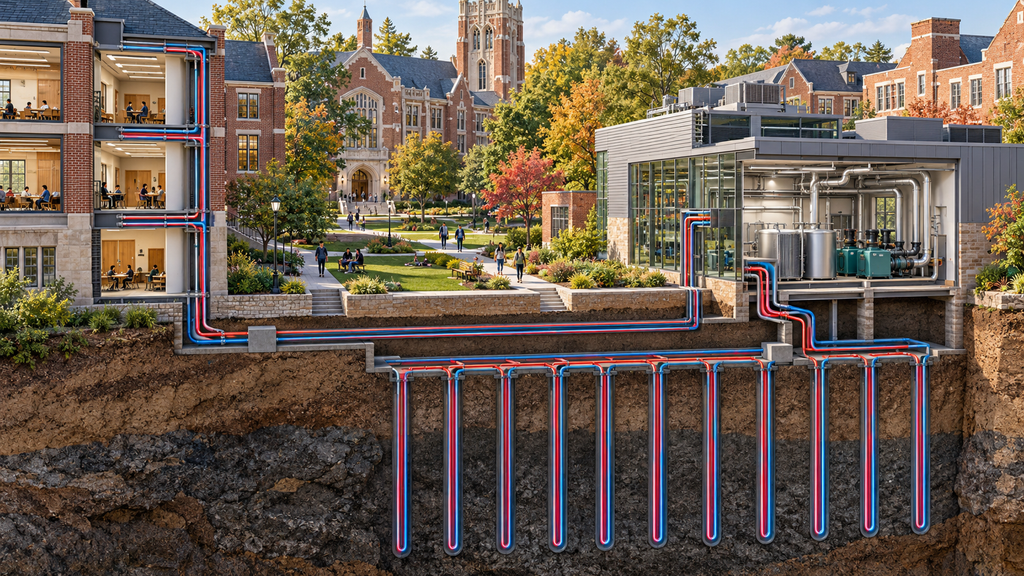
Geothermal campus retrofits can create a much broader scope of work than installing an underground loop. For public universities, connecting existing buildings to a ground-source heating and cooling system can require HVAC assessments, thermal distribution upgrades, electrical planning, controls integration, and phased construction.
For geothermal contractors, HVAC firms, and engineering consultants, the useful early signal is the combination of funding, named facilities, and a defined infrastructure change. The next step is understanding which technical decisions and procurement packages remain ahead.
SUNY Oswego Shows How Geothermal Expansion Connects to Campus Renovation
In an August 2026 update, SUNY Oswego confirmed that a $30 million climate resiliency grant supports a thermal network expansion tied to renovations at Mahar Hall, Culkin Hall, Penfield Library, and Lanigan Lecture Center.
The announcement connects geothermal infrastructure with multiple building projects. That makes the engineering question more specific: how will each facility connect to the network, and which existing systems must change?
The grant amount should not be treated as the value of an available vendor contract. The announcement also does not establish that every design or construction package is still unawarded. Firms evaluating this signal should verify current solicitations, project ownership, and award notices for the particular scope they can deliver.
What a Campus Geothermal HVAC System Actually Includes
The U.S. Department of Energy describes geothermal heat pumps as electrically powered systems that transfer heat between buildings and the ground. A system includes an underground heat collector, heat pump equipment, and a building heat distribution subsystem.
In a closed-loop installation, fluid circulates through buried piping to exchange heat with the surrounding earth. The ground serves as a heat source during heating and a heat sink during cooling. These projects use ground-source heat exchange; they do not require the high-temperature geothermal resources used for electricity generation.
A campus thermal energy network adds a shared distribution layer. The DOE overview of geothermal heating and cooling includes networked geothermal applications for campuses and communities. Actual configurations vary: building heat pumps, central equipment, heat recovery, storage, and supplemental systems may be combined differently.
This variation matters commercially. A borefield contractor, mechanical contractor, controls integrator, and engineering consultant may each fit a different package within the same capital program.
Existing Building HVAC Compatibility Is a Critical Engineering Question
An existing campus building isn’t automatically ready for a new thermal network just because it already has heating and cooling equipment. The engineering assessment must connect the proposed network temperatures and capacity to the building’s actual loads and distribution systems.
Princeton’s campus infrastructure program illustrates the breadth of that transition. Its published plan combines geo-exchange borefields, heat pump facilities, campus piping, and building heating and cooling conversions as it shifts from steam to hot water.
For firms assessing comparable projects, useful questions include:
- Can existing coils and terminal units meet heating demand at the proposed supply-water temperature?
- Which buildings need envelope improvements, distribution changes, or terminal equipment replacement?
- How will ventilation, humidity control, and specialized laboratory loads be served?
- What changes are needed to pumping, balancing, and building automation?
- Which facilities require temporary heating or cooling during conversion?
These are due-diligence questions, rather than confirmed requirements for the Oswego project. They help turn a general decarbonization announcement into a defined technical conversation.
Borefield Design Requires More Than a Peak Load Estimate
The ground loop must work with the buildings it serves over time. Early screening should distinguish the highest heating or cooling demand from the annual pattern of heat extraction and rejection.
Princeton’s published borefield description explains that its closed-loop piping transfers heat through conduction and that summer heat can be retained for winter use. That example makes the relationship between seasonal operation and subsurface conditions easier to see. It does not establish a universal bore depth or design for other campuses.
During feasibility and design, project teams should resolve questions such as:
- What site investigation and subsurface testing will inform the design?
- How do geology, available land, buried utilities, and drilling access constrain the field?
- How will the connected buildings’ annual heating and cooling profiles affect long-term ground temperatures?
- Will heat recovery, supplemental heat rejection, or other equipment be needed?
- How will later building connections change the original assumptions?
For geotechnical and geothermal engineering firms, these questions can reveal the need for investigation or design support before finalizing equipment quantities. A sustainability goal alone provides much less information than a funded feasibility study with named buildings and a proposed loop location.
Electrical Capacity and Controls Belong in the Retrofit Scope
Heat pumps use electricity to move heat. Campus electrification planning therefore needs to assess when new electrical demand will occur and whether existing service, distribution, and equipment can support it.
An initial scope review should ask about service capacity, transformer and switchgear requirements, equipment lead times, and the sequence of building conversions. These factors may affect delivery even when the thermal design is feasible.
Controls deserve the same attention. Operators need a coordinated sequence for heat pumps, circulation pumps, valves, and any supplemental equipment. Metering and trend data should help the facilities team understand delivered heating and cooling, electricity use, and system performance.
For controls firms, the relevant signal may appear in a building automation upgrade or commissioning scope rather than in a notice titled “geothermal.” Searching only for the technology name can miss related work.
Phased Construction and Commissioning Create Distinct Work Packages
Campus projects must account for teaching schedules, building occupancy, utility access, and continuity of service. Teams can install a thermal network in stages while individual buildings are renovated and connected at different times.
This raises practical questions about temporary systems, utility shutdowns, restoring grounds, and responsibilities at each interface. Project teams should define who tests the buried loop, verifies building connections, checks control sequences, and trains operators.
The Federal Energy Management Program’s geothermal heat pump specification template provides a customizable starting point for federal closed-loop procurements, covering water-to-air and water-to-water systems. University and municipal teams must adapt specifications to their own projects and procurement requirements.
For vendors, a phased program may include separate opportunities for engineering, drilling, mechanical, electrical, and commissioning. Vendors must verify the package structure from project documents rather than infer it from the total funding announcement.
Which Public Records Reveal Early Geothermal Project Signals
The following framework is an analytical guide for evaluating project maturity. It is not a claim that a specific procurement is open.
| Public record or signal | What it helps establish | Follow-up question |
| Energy or facilities master plan | Institutional direction and candidate facilities | Is geothermal an option under review or an approved approach? |
| Grant award or capital appropriation | Funding tied to a stated purpose | Does it fund studies, design, construction, or several phases? |
| Feasibility study authorization | Work to test technical and financial assumptions | Has the study provider already been selected? |
| Renovation plan naming buildings | Potential timing for HVAC conversion | Are thermal connections included in each project’s scope? |
| Design solicitation or board approval | A more defined project and delivery stage | Which engineering disciplines and packages remain available? |
| Bid notice or award notice | Current procurement or selected delivery partners | What scope is open, and what has already been awarded? |
Read these records together. Funding without a defined scope may signal a project worth monitoring. A named building renovation with a design authorization can provide a clearer next step. An award notice can close one opportunity while pointing to later phases or related packages.
What HVAC and Engineering Firms Should Verify Before Outreach
A useful opportunity assessment should identify the owner, funding purpose, affected buildings, current project stage, delivery method, and relevant scope. It should also identify who manages procurement, which partners have been appointed, and when the next decision is expected.
Technical fit matters as much as timing. A firm specializing in hydronic conversions should look for work in existing buildings. A geothermal drilling contractor needs evidence of borefield scope. A controls provider needs to understand automation interfaces and commissioning responsibilities.
SUNY Oswego’s expansion shows why geothermal infrastructure deserves attention across several disciplines. The broader lesson is that campus decarbonization signals become useful when firms connect funding and renovation plans to specific engineering decisions, then verify the procurement status of the work they can deliver. Explore the related Osserva geothermal, HVAC, and engineering project signal.
Referenced in the article:
- SUNY Oswego: Geothermal expansion and $30 million grant
- U.S. Department of Energy: Geothermal Heat Pumps
- U.S. Department of Energy: Geothermal Heating and Cooling
- Princeton University: Path to Net-Zero Campus Upgrades
- Princeton University: Geo-Exchange Bore Fields
- Federal Energy Management Program: Geothermal Heat Pump System Technical Specifications
- Osserva: Related Geothermal, HVAC, and Engineering Project Signal