
Selling B2B Into Enterprise: A Guide for 2026

Selling B2B into enterprise has never been more challenging or more vital to revenue growth. As organizations reconsider their approach to purchasing and investing in digital transformation, enterprise buyers are increasingly doing their own research. They are more value-aware of vendors before contacting the sales team.
Any effective enterprise sales plan must involve keen knowledge of current buyer behavior, data-driven interaction, and a systematic process of making long-cycle decisions.
This guide explores what enterprise selling would look like in 2026, drawing on reliable research and industry data.
The Enterprise Buying Landscape in 2026
The nature of enterprise sales has never been short-cycle or multi-stakeholder, but current trends indicate a shift towards shorter response times and greater self-service.
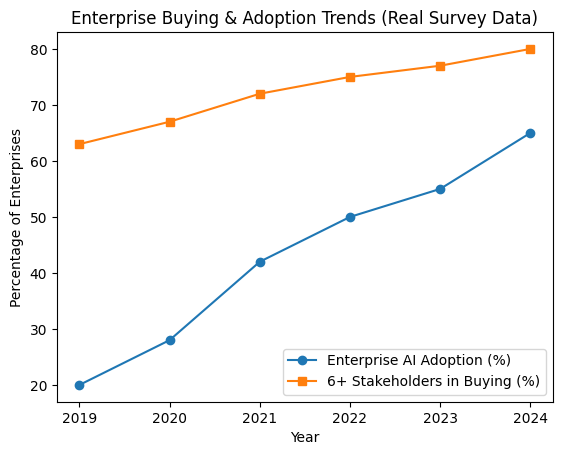
Gartner estimates that by 2026, 65% of B2B sales organizations will have moved toward data-driven decision-making instead of using intuition, using analytics and digital workflows to interact with buyers with greater insights and less guesswork. This shift reflects an industry-wide demand for precision and alignment on both sides of the sales process.
Continuing on this digital transformation, studies indicate that most B2B interactions are currently executed through digital channels. By 2025 and beyond, 80% of B2B enterprise selling will take place on digital platforms, compelling sellers to adopt digital interaction as a strategic enterprise sales behavior rather than a tactic.
Enterprise buyers themselves behave differently from their small and mid-market counterparts. Complex decision units - often involving 6–10 stakeholders with varied priorities- require a sales motion that supports multiple parallel dialogues rather than a single champion.
Such complexity and high demands of digital purchasing experiences radically alter the way sellers interact.
Why Enterprise Sales Need a Strategic Framework
- Enterprise deals are big, risky, and their assessment process takes a long time. It also involves various compliance measures and a multi-stakeholder agreement.
- Enterprise purchasers are well informed and prefer wisdom-based dialogue instead of being introduced to sales advertisements.
- According to Forrester research, buyers can do the majority of their research, then talk to sales, and shift the initial conversation to validation and differentiation.
- Enterprise selling should transition in 2026 to value-based proactive outreach rather than reactive.
- Account-based selling, strategic enablement, and consultative engagement are structured strategies required to meet the enterprise-level knowledge expectations of their partners.
Building a Modern Enterprise Sales Strategy
The business buyer process is linear in an enterprise sales strategy. Studies indicate that B2B consumers are doing approximately 70-80% of their purchase research on their own, and 39% rely on it as a “core growth engine” for revenue targets, before sales involvement.
Before buyers invite a vendor to their discussions, they utilize digital resources, peer reviews, analyst reports, and internal analyses.
This trend highlights one of the key shifts sellers must undergo: early influence occurs beyond conventional sales channels. Enterprise sellers need to use strategies to gain trust and credibility early on via educational content, digital self-serve materials, and interaction across touchpoints.
Embrace Data-Driven Decisions
In 2026, data will become a competitive edge in business sales. According to Forrester research, the shift to data-based selling, in which analytics are used to choose whom to target, with what message, and when, is enormous.
Sales teams that can project predictive signals about buyer intent will always be ahead of competitors who rely on intuition or poor CRM inputs.
This approach requires investments in sales technology stacks that integrate account intelligence, buyer interactions, and predictive outcomes.
Platforms that unify these signals - from CRM, marketing automation, and intent data providers - help sellers identify high-potential accounts earlier and invest effort where it matters most.
Account-Based Selling for High-Value Wins
Account-based selling (ABS) is a strategy in the enterprise markets where a limited number of deals can determine the annual performance. ABS is centred on identifying high-value accounts, mapping decision units, and engaging stakeholders based on their needs rather than on general engagement.
The resulting prioritization will enhance relevance and reduce the amount of wasted effort on the accounts that will not convert.
Even successful ABS programs are able to align marketing and sales efforts to deliver the same message and touchpoints at all places in the buyer journey. Co-ordinated campaigns, content, and sales outreach help teams direct stakeholders to make complicated purchases with certainty and clarity.
Hybrid and Digital-First Engagement Models
The most powerful model of selling in enterprise markets is beginning to take shape as hybrid selling. According to McKinsey research, the successes tend to reduce the distinctions between remote interactions to reach a wide range of people and executive briefings to manage the discussions of value creation. Remote engagement reduces friction while human counsel adds context and trust at key moments.
In 2026, enterprise sellers must optimize digital channels while retaining human expertise for strategic alignment and negotiation. Buyers appreciate seamless digital experiences but still value human insight for complex business cases.

Image Alt: Businessman showing a rising trend in an iPad for selling B2B into an enterprise
Key Trends Shaping Enterprise Sales in 2026
In Enterprise sales trends 2026, consumers are demandingmore self-service features that reflect the B2C experiences - in access to detailed product descriptions as well as in transparent pricing and an account management dashboard.
According to McKinsey, purchases of high value (i. e., orders ov\
er 500,000) are now acceptable via remote and self-serve channels because customers are demanding convenience in addition to consulting support.
Sales teams must ensure that their digital environments support research, comparison, and evaluation without manual intervention, enabling prospects to advance on their own terms and reach sellers when they are ready.
AI and Predictive Analytics Accelerate Engagement
AI adoption is an operational reality. By 2025, a massive majority of B2B sales organizations will have integrated AI into the primary operations of lead scoring, subdivision, and outreach personalization. The trend is observed up to 2026, when AI is already being used to eliminate manual activities in organizations as they focus on strategic engagement.
AI also enhances forecast accuracy and prioritizes accounts showing real buying signals, allowing sales teams to invest time where it drives the highest return.
Personalization Is Not Optional
Relevance and trust are driven by personalization, especially in an enterprise where there are many stakeholders with different priorities.
B2B leaders are increasingly investing in analytics and solutions to customize communications at each phase of the purchasing process, recognizing that generic contact cannot be effective with knowledgeable, technologically skilled customers.
Delivering contextually relevant insights to decision units builds credibility and differentiates sellers from commoditized alternatives.
What Success Looks Like in 2026 for Selling B2B into Enterprise
- In 2026, success is characterized by predictable pipelines, reduced sales cycles, and better-quality buyer engagement, rather than quota achievement.
- Data-driven frameworks, strong account intelligence, and optimized hybrid selling models replace uncertainty with consistency.
- Alignment between revenue operations, marketing, and sales improves visibility across the buying journey and speeds up response to buyer signals.
- Sales teams equipped with analytics, AI tools, and structured playbooks consistently outperform those relying on reactive, traditional selling approaches.
The Future of Enterprise Sales
Selling B2B to the Enterprise in 2026 will be shaped by digital sophistication, buyer autonomy, and strategic enablement. Sellers who master guided engagement, personalized outreach, and predictive targeting will capture the most valuable deals.
As budgets tighten and decision cycles lengthen, value-led engagement backed by data, supported by technology, and delivered through coordinated teams will define winning enterprise sales organizations.
If your sales strategy in 2026 isn’t guiding enterprise buyers across their digital journey, answering pre-purchase questions, and aligning internal processes to buyer expectations, you risk losing relevance to competitors who do.