

For many municipalities, digital accessibility has traditionally been treated as a website-maintenance responsibility. Everything from a broken heading structure to an unlabeled form field or an inaccessible PDF would be sent to the communications or web team for correction.
That approach is no longer sufficient.
The U.S. Department of Justice’s updated Title II rule establishes WCAG 2.1 Level AA as the technical standard for web content and mobile applications provided by state and local governments. Larger public entities generally have until April 26, 2027, to comply, while smaller entities and special district governments generally have until April 26, 2028.
Although the deadlines may appear distant, the work involved extends well beyond repairing a municipal homepage. Compliance may require an inventory of nearly every digital system through which the public accesses a government service.
Accessibility is Extending Across Online Permitting Platforms
A resident may interact with a municipality through dozens of systems:
- Utility billing portals
- Online permitting platforms
- Recreational registration systems
- Public meetings
- Employment applications
- Transit information
- Emergency notifications
- Property and tax portals
- Mobile applications
- Digital forms and downloadable documents
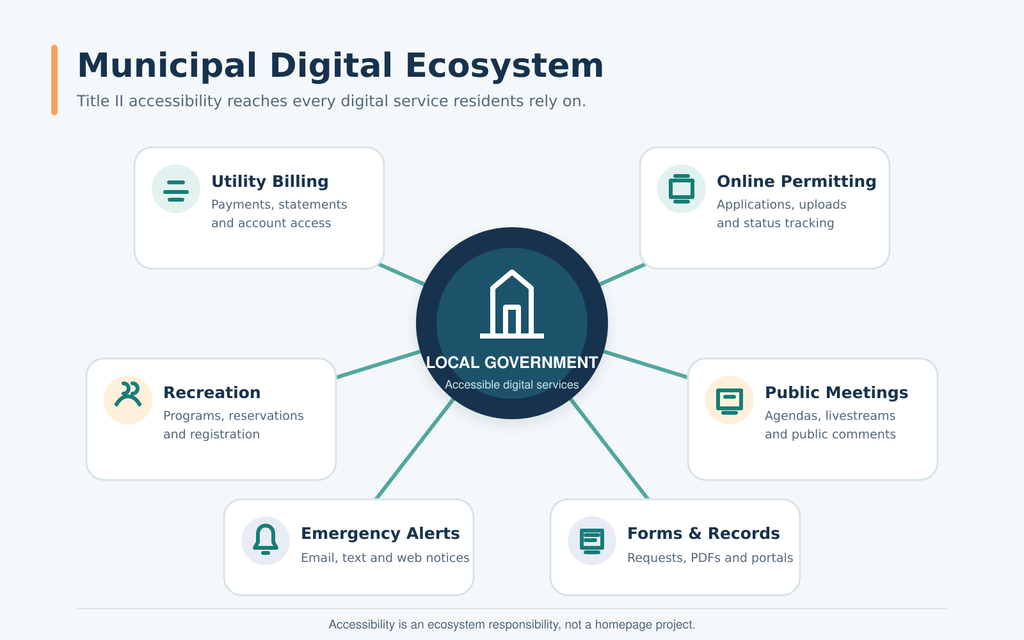
These are often serviced through separate vendors, departmental budgets, administrative owners, and contract cycles. A municipality may therefore have a polished and accessible primary website while still presenting significant barriers inside the applications residents actually use.
The central challenge is not simply identifying accessibility defects. It is identifying ownership.
Which department controls the application? Who manages the vendor relationship? Does the contract contain accessibility requirements? Can the municipality obtain testing results? Is remediation possible within the current product, or will it require a replacement procurement?
Without a portfolio-level view, teams usually answer these questions one system at a time—often only after a resident encounters a barrier.
The Inventory Is the First Difficult Step
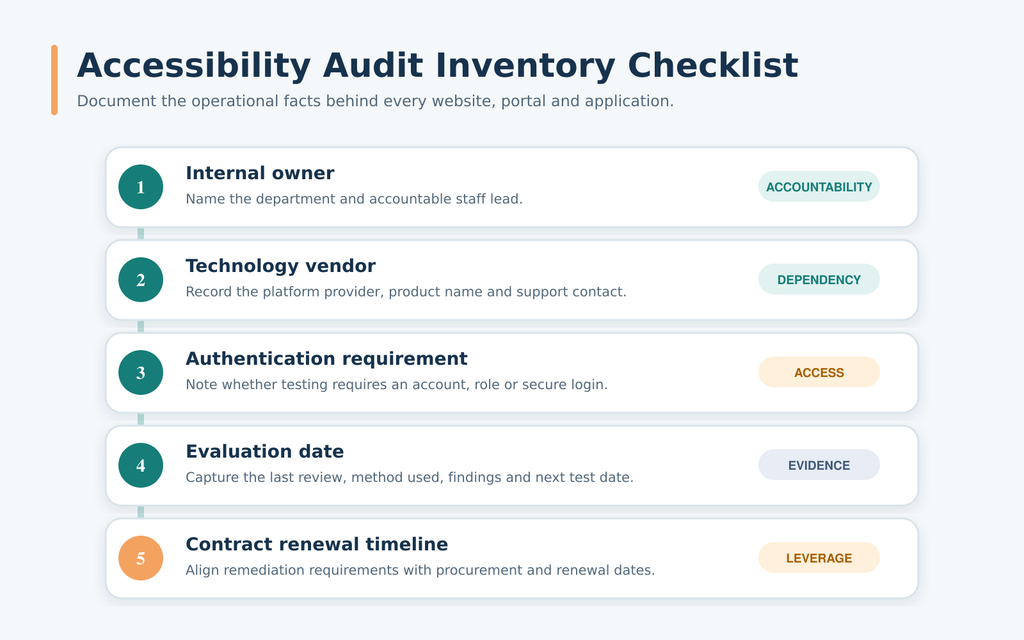
A useful accessibility audit should begin with a complete inventory of public-facing digital services, not just a scan of the primary website.
For every system, municipalities should document:
- The service and population it supports
- The internal system owner
- The technology vendor
- Whether the experience is web-based, mobile, document-based, or embedded
- Whether authentication is required
- The date of the most recent accessibility evaluation
- Known barriers and reported complaints.
- Contract renewal and replacement dates
- Available accessibility documentation
- The operational consequence if the service is inaccessible
This inventory lets you prioritize systems by public impact rather than technical convenience.
A keyboard-navigation defect on a lightly visited informational page and an inaccessible field in an online benefits application may both violate the same technical success criterion. Their practical consequences, however, differ greatly.
Automated Scans Are Only an Entry Point
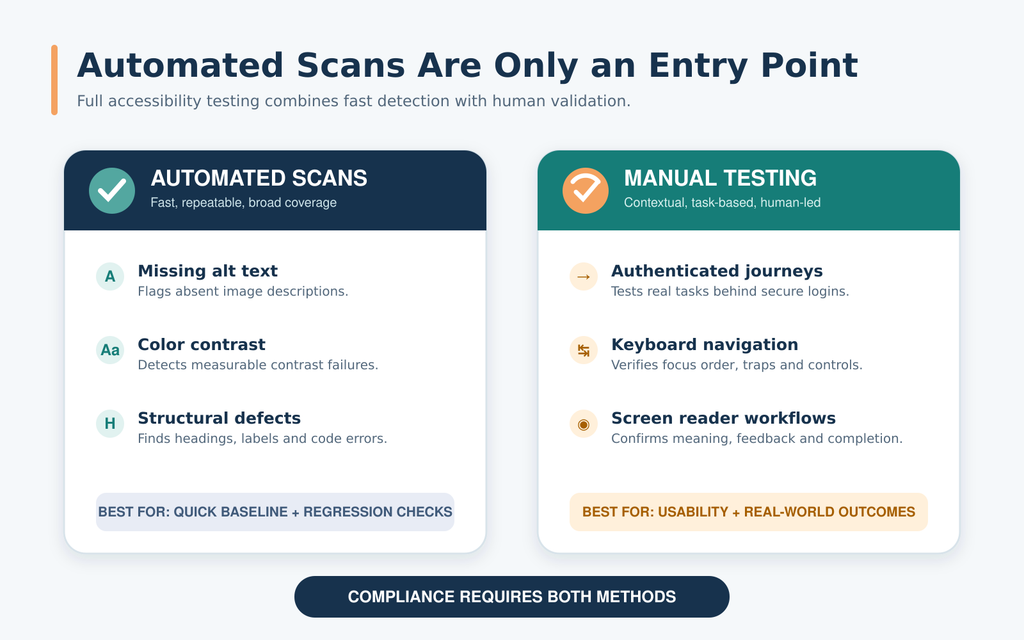
Automated accessibility tools help identify recurring problems such as missing alternative text, insufficient color contrast, duplicate element identifiers, and unlabeled form controls.
They cannot determine whether an entire service is meaningfully usable.
Manual testing is still needed to evaluate keyboard navigation, focus order, screen reader behavior, form instructions, error recovery, time limits, authentication, document workflows, and the completion of multi-step transactions.
Authenticated applications deserve particular attention. Many automated scans evaluate only publicly accessible pages. The most consequential barriers may exist after a resident signs in, uploads documentation, enters payment information, or attempts to submit a form.
Testing should therefore follow complete user journeys rather than isolated URLs.
Documents Create a Separate Governance Problem
Municipal websites often contain thousands of PDFs, spreadsheets, presentations, meeting packets, public notices, and scanned records.
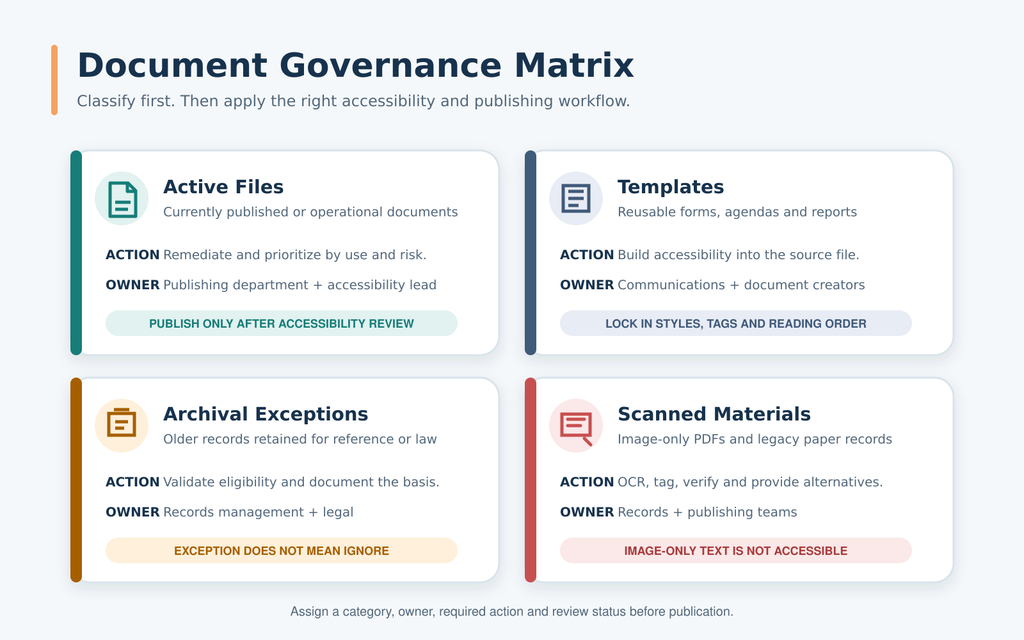
The Title II rule includes limited exceptions for certain archived materials and preexisting conventional electronic documents. Those exceptions do not mean that every older file can be labeled an archive. Content that remains in active use—or is needed to apply for, access, or participate in a public service—may still need to be accessible.
A document strategy should distinguish among:
- Active documents that require remediation
- Templates used to create future documents
- Historical records eligible for an exception
- Scanned materials requiring an accessible alternative
- Duplicate or obsolete files that can be retired
- Documents generated automatically by another system
This is a records-management and publishing-governance issue as much as an accessibility issue.
Contracts May Determine What Is Technically Possible
A municipality can identify an accessibility problem without having the contractual ability to fix it.
Vendor agreements may not guarantee conformance, provide access to testing documentation, establish remediation timelines, or allow the government to inspect accessibility performance. Some platforms may require the vendor to make every substantive correction.
Upcoming renewals should therefore be evaluated as decision points for accessibility. Waiting until shortly before the compliance deadline could leave a municipality locked into a multiyear agreement for a system that cannot be brought into conformance quickly.
Procurement, legal, technology, communications, records, and departmental program owners all have a role in preventing that outcome.
The Immediate Opportunity Is Visibility
Municipalities do not need to resolve every accessibility issue before beginning the process. They do need an accurate view of their exposure.
A defensible program starts by identifying the services residents rely on, testing the complete experience, assigning ownership, documenting decisions, and building remediation into technology and procurement planning.
Deadlines matter, but the deeper issue is continuous accessibility. Every new application, uploaded document, software release, and vendor renewal can either reduce barriers or reintroduce them.
For public entities, accessibility is becoming a permanent requirement of technology governance—not a one-time website project.
Reference: DOJ guidance on the Title II web and mobile-app accessibility rule